I posted last month about what’s new in VMware Cloud on AWS, particularly as it related to stretched cluster and HCX enhancements. The team has been working hard on some more new features, and I thought I’d cover them off briefly here. More detail can be found in the VMware Cloud on AWS Release Notes are here, and there’s a great blog post from the team here.
What’s New?
New Host Usage Report API
Have you been wondering what’s going on with resources in your VMC on AWS environment? Wonder no more. All the cool cloud kids are using APIs, and VMC on AWS is no different. Now you can retrieve daily host usage reports for any date range and filter by region, instance type, SKU, and other attributes – all via the API. There’s no need to call me and ask for a report on what’s happening, nor do you need to log a ticket to get access to the information. Here’s what a sample query looks like.
curl -H 'Authorization: <value>' https://{api_host}/api/activityanalytic/{org_id}/hosts/{freq}/usage-report?start_date=value&end_date=v
Check out the documentation here.
Redesigned VMware Cloud on AWS UI
The VMware Cloud on AWS UI has also had a facelift, and the interface is more streamlined and easier to navigate. You can access it at https://vmc.broadcom.com.
VMC Sizer & Cluster Conversion Updates
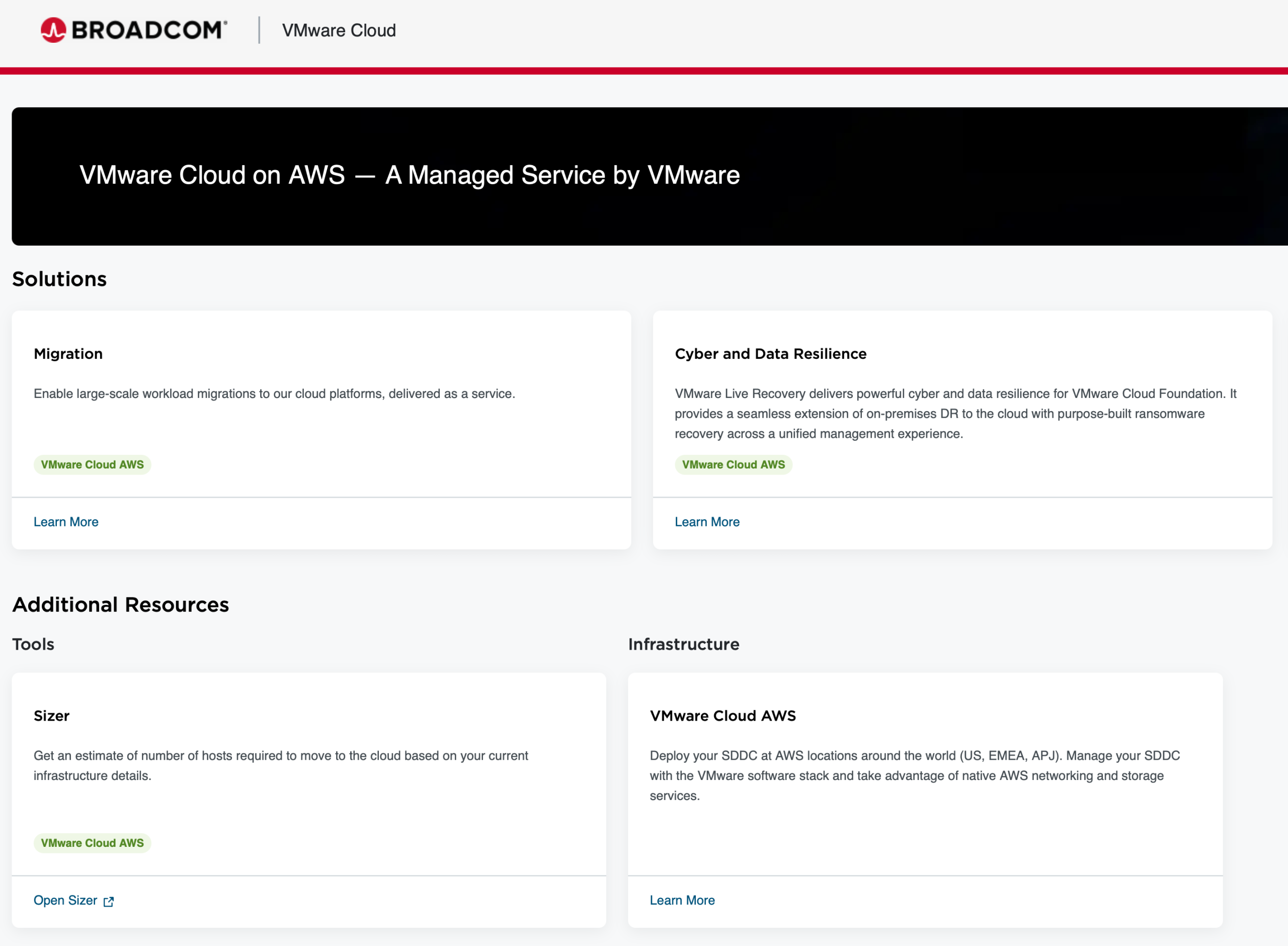
Ever since I started working with VMware Cloud on AWS, I’ve been a huge fan of the VMC Sizer tool. It’s so much better than trying to build solution estimates with a spreadsheet and a dream. If you’re an existing I3.metal customer, you’ve likely (hopefully) been planning a migration to I3en.metal or I4i.metal nodes. The conversion estimates can be a bit of a mystery, and have frequently required involving people like me and folks from the SRE team to provide these estimates. The product team has been working to make the process more streamlined, while giving customers improved visibility into why the numbers are the way they are. The output from sizing estimates now provides clear reasoning behind why a specific number of hosts is required, and this is based on 6 elements (compute, memory, storage utilisation (with both conservative and aggressive options), vSAN storage policies, and NSX Edges). It’s never been a simple matter of saying two I3.metal hosts equals one I4i.metal host, and now the sizer output reflects this more clearly.
The following constraints should be noted:
- Final host counts and sizing will be validated during the actual cluster conversion. Sometimes you end up with more, sometimes you end up with fewer hosts.
- Customers should re-run sizing evaluations after any significant configuration, resource, or other changes. Please don’t add another 30TiB workload to your cluster and expect the same result.
- No RAID policy changes are made during conversion. This is especially notable if you’re using custom storage policies in your environment.
- Subscription estimates provided as part of this workflow are for planning purposes only and do not represent guaranteed final requirements.
- Actual subscription needs may be higher than estimated, requiring additional subscription purchase post-conversion. You’re given a small window to make good on this.
- Refunds or subscription reductions will not be provided if estimates exceed actual needs.
Thoughts
As I mentioned in my previous post, VMware Cloud on AWS is not going anywhere, and the product and engineering teams continue to innovate and work hard to ensure that users get the best value from their investment in the VMware Cloud on AWS solution. The Host Usage Report is extremely useful, and for those customers concerned about cluster conversions, the improvements to the VMC Sizer should improve the confidence in the sizing process.