Random Short Take #109

Random short take #109. Looking for news that’s old? You’ve come to the right place. Let’s get random.

  • This opinion piece would be hilarious, if it wasn’t so alarmingly accurate. We weren’t allowed to trust Wikipedia articles but whatever AI tells us is just fine? Let’s pump the brakes and reflect, please.
  • And speaking of art and artifice, this post from John Birmingham on digital media versus holding the art in your hand was great.
  • Need to store that digital media somewhere? Backblaze knows a bit about that. Read the Q2 2026 Drive Stats report here.
  • Speaking of storage, this article over at El Reg on the Domesday Project was pretty cool.
  • And while we’re talking long-term storage, in press release news, check out what Cerabyte has been up to.
  • In people news, Preston de Guise is looking for a job. Hire him if you need someone smart who can really help your organisation.
  • I’m not looking to return to the world of home lab builds, but if you’re looking for a primer, this article covers off some of the basics really well.
  • And this is just … ugh.

Brisbane VMUG – July 2026

The July 2026 edition of the Brisbane VMUG meeting will be held on Thursday 23rd July at the NetApp Office, Level 17, Central Plaza II, 66 Eagle Street, Brisbane from 3pm – 6:30pm. It’s sponsored by NetApp, Ingram Micro, and Broadcom and promises to be a great afternoon.

Here’s the agenda:

3pm – VMUG Leader Intro

3.10-4pm – Unlock unrealised value from your VCF deployments with NetApp ONTAP 9.1

Presented by Chris Gondek – Solutions Engineering Manager, Australia and New Zealand, NetApp and Wade Juppenlatz – Technical Business Development Manager, Ingram Micro

Live demonstration of the NetApp Data Infrastructure insights Observability of VMware environments.

  • Showcasing where there are opportunities to right size
  • Where there is over/under utilisation/provisioning
  • Where there is opportunity to reclaim waste
  • Audience Participation / interaction where you can ask your own questions to the NetApp AI chat bot on VMware environments
  • Always popular, you can ask anything that you would want, in natural language like “show me where I save on VMware licensing cost”, etc)
  • Trident for TANZU / VKS
  • Our ONTAP tools for VMware integration / UX demo
  • Broader VMware in cloud and the NetApp Console Canvas
  • Shift Toolkit (Convert/Migrate other HyperVisor environments to VMware)

4-4.30pm – VCF 9.1 Introduction and Updates from Broadcom

Presented by Peter Hauck, Staff Solutions Architect, Broadcom

4.30-5pm – Community Session (tbc)

5pm onwards – Networking, Pizza, vBeers and Giveaways!

You can find out more information and register for the event here.

Random Short Take #107

Random short take #107. Looking for old news? I’ve got just the thing. Let’s get random.

  • This article from Matt Allford struck a chord. I have an awful lot of USB cables in my house, and I have no idea what the specs of most of them are.
  • Speaking of things I only have a superficial understanding of, this article from Christian on Intel Arc SR-IOV hardware transcoding with Plex on Proxmox VE was great.
  • Still using an Apple Time Capsule? You’re out of luck and in luck at the same time, as is explained over at The Register.
  • Speaking of backup and recovery, this article about Backblaze has me questioning everything I’m doing to keep stuff safe at home. I’ve checked that my iCloud data is protected (and recoverable), but only because the machine I have Backblaze installed on has downloaded copies of that data. For the stuff I keep on Dropbox and Google Drive, it doesn’t seem as straight forward. Not that I’d ever recommend you only keep data with one provider. Maybe I need to write something more about this, if only to confirm that I’m doing correctly myself.
  • In resilience news (is that really a category?), this was an interesting article on AWS and what’s happening in the Middle East. The response from AWS has been fascinating, as have some of the hot takes from so-called “disaster recovery experts”. I’m looking forward to talking with customers in Western Queensland about the risk matrix they’ve drawn up that has them in a tizzy about losing three availability zones. There’s preparedness and then there’s how you recover, I guess.
  • Missing using FireWire with the most recent version of macOS? This article from Jeff Geerling might be of use if you still have a MiniDV camera you need to connect to something. It just won’t be with macOS.
  • Speaking of things not working after updates, you could always follow John Birmingham’s advice and just never update. But I’m not sure that’s really sustainable.
  • I think Netflix does some really cool stuff from a technical perspective, but for the most part the catalogue seems to be trash. So these kinds of posts from people rediscovering physical media are always nice to read.

Random Short Take #106

Random short take #106. Looking for old news? I’ve got just the thing. Let’s get random.

Random Short Take #105

Random short take #105. Want news? Sorry I’ve had a bit on. Let’s get random.

Random Short Take #104

Random short take #104. Want news? This is where news goes to die. Let’s get random.

Random Short Take #103

Random short take #103. Want news? You’re probably not in the right place. Let’s get random.

Nexsan Announces Unity NV4000

Nexsan recently announced the Nexsan Unity NV4000. I had the chance to speak to Vincent Phillips (CEO), Judy Kaldenberg (SVP Sales & Marketing), and Mircea Turcu (VP of Engineering) about it, and thought I’d share some thoughts here.


What Is It?

[image courtesy of Nexsan]

I’ve said it before (a little over a year ago as it happens), and I’ll say it again … in the immortal words of Silicon Valley: “It’s a box“. And a reasonably powerful one at that, coming loaded with the following specifications.

Supported Protocols SAN (Fibre Channel, iSCSI), NAS (NFS, SMB 1.0 to 3.0, FTP), Object (S3)
Disk Bays | Rack U 24 | 4RU
Supported Expansion Systems N/A
Maximum Raw Capacity 576 TB Raw
System Memory (DRAM) per controller up to 128GB
FASTier 2.5″ SSD Drives (TB) 1.92 | 3.84 | 7.68 | 15.36
SAS SSDs (TB) 1.92 | 3.84 | 7.68 | 15.36 | 30.72
SAS HDDs (TB) 4 | 6 | 8 | 10 | 12 | 14 | 16| 18 | 20 | 22 | 24
Host Connectivity 16/32Gb FC | 10/25/40/100 GbE

It’s a dual-controller platform, with dual Intel Xeon Silver 4309Y CPUs (2.8 GHz CPU, 8 cores, 16 threads) per controller, and you get access to the following features included as part of the platform license:

  • Nexsan’s FASTier® Caching – Use solid-state to accelerate the performance of the underlying spinning disks
  • Nexsan Unity software version 7.2, with important enhancements to power, enterprise-class security, compliance, and ransomware protection
  • Enhanced Performance – Up to 1,000,000 IOPs
  • Third-Party Software Support – Windows VSS, VMware, VAAI, Commvault, Veeam Ready Repository, and more
  • Multi-Protocol Support – SAN (Fibre Channel, iSCSI), NAS (NFS, CIF, SMB1 to SMB3, FTP), Object (S3), 16/32GB FC, 10/25/40/100 GbE
  • High Availability – No single point-of-failure architecture with dual redundant storage controllers, redundant power supplies and RAID


Other Features (via Unity 7.2)

Along with the standard Unity features, with the release of Unity 7.2, you also get access the new Cloud Connector, offering bi-directional sync for files / directories with cloud storage solutions such as AWS S3, Azure Blob, and Unity Object store. As well as this, an SMB Access Audit capability has been introduced with the new version of Unity, given administrators the ability to view file access by user via the SMB protocol.


Use Cases

The Unity NV series of arrays is well suited to the following workloads:

  • Media and entertainment;
  • Hypervisor storage (primary and secondary);
  • Digital video surveillance; and
  • Backup and recovery storage.


Thoughts and Further Reading

I wrote about the NV6000 when it was announced in January last year. At the time I wondered, somewhat tongue in cheek, who really cared about storage array announcements in this age of hyperscaler storage solutions. But I think plenty of people should and do care that these kinds of products are out there in the market. As with the other Unity solutions, the NV4000 provides users some degree of flexibility when it comes to the protocols they want to use (SMB, NFS, iSCSI) and the transport mechanisms (FC, Ethernet). For every pundit pronouncing the death of fibre channel, there are any number of folks out in the field still running those networks from a bygone era, and quite happily to boot. The smaller footprint of the NV4000 may not be that exciting for those of us craving large scale storage capacities and high performance arrays to do the heavy lifting for our critical workloads, but these kinds of solutions are great at the edge or in places where you can’t simply roll in a full rack of storage. As well as this, in a society increasingly fascinated with surveillance, solutions like the NV4000 provide a robust solution for the storage of CCTV footage, and Nexsan also seems very focussed on solving this problem efficiently and cost-effectively.

Hybrid storage is still a real thing in the wild, because people are still looking for ways to store more and more data in a cost effective manner, and providing support for spinning disks in storage arrays, with some clever caching / storage tiering up front, is one way of doing that. Particularly when that storage needs to happen at the edge, or in places where clouds can’t be easily reached. While it seems like an odd concept for people working with data in places where big fibre runs exist to their hyperscaler of choice, there are plenty of places (like most of Australia) where moving large volumes of data between the cloud and local workloads still isn’t a terribly fast (or cheap) activity. Until that problem is somehow solved (and I know it’s being worked on by many companies) midrange, on-premises storage isn’t dead yet.
Random Short Take #102

Random short take #102. You’ll see from the age of some of these stories that this one has been in drafts for far too long.

StorPool Announces Disaster Recovery Engine For KVM-based Clouds

StorPool recently announced its Disaster Recovery Engine (DRE) for KVM-based clouds. I had the chance to talk to Dave Henry and Beth Caltagirone about the announcement and thought I’d share some thoughts here.


What It Does

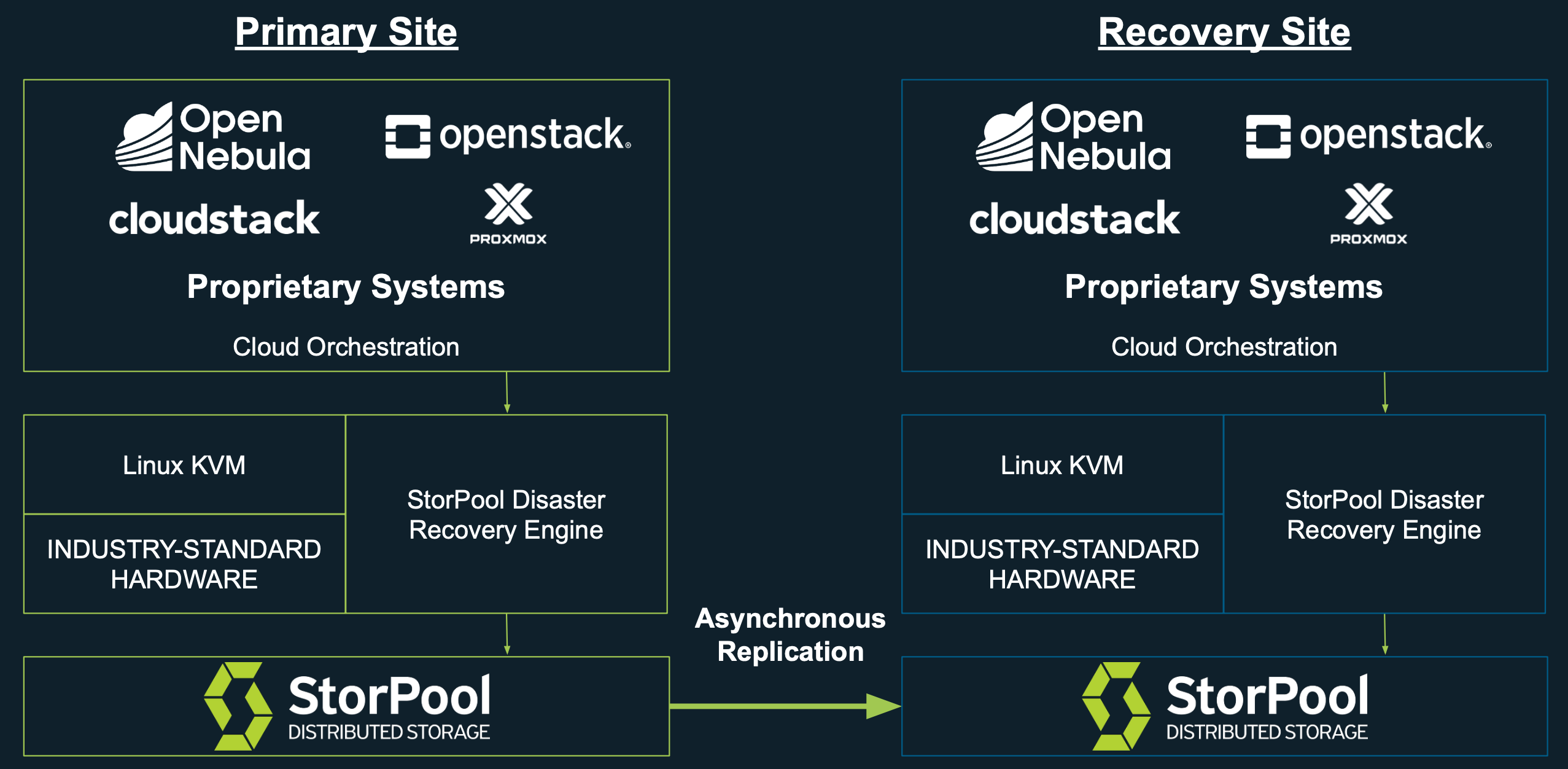
According to StorPool, the DRE “can protect environments with tens to thousands of VMs. It simplifies disaster recovery scenarios like 1:1, many to 1, many to many, and delivers industry-leading recovery point objective (RPO) and recovery time objective (RTO) of virtual machines in disaster scenarios, to ensure uninterrupted business operations.” At its core, it’s a way to get data from point A to point B, and use that data in the event that point A goes away.

[image courtesy of StorPool]

It supports asynchronous replication down to a 15-minute recovery point objective, and, according to Henry, can deliver some pretty snappy recovery times (depending on the hardware deployed at the recovery site).

Supported Topologies

There are several topologies supported, including:

  • Active – Passive;
  • Bi-directional;
  • Many-to-one; and
  • Multi-site mesh.

The choice of topology will be dependent on various environmental factors, such as distance between sites, the type of disaster you’re looking to recover from, etc. But I’m sure this level of flexibility would be appreciated by StorPool customers.

Licensing

Existing and new customers will be pleased to hear that the StorPool Disaster Recovery Engine is fully integrated with StorPool’s existing licensing – no additional license is required.


Who’s Using It?

“StorPool customers are IT service providers building public, private and hybrid clouds – Managed Service Providers, Hosting Service Providers, Cloud Service Providers, Enterprises and SaaS vendors. The StorPool Storage platform is a Storage-as-a-Service (STaaS) offering, with a bring your own server model.” CloudSigma has been using the product to offer DR capabilities to its customers across 31 sites globally.


Thoughts

In terms of hypervisors, I’ve been working almost exclusively with VMware for the last twenty years (well, except for that weird XenServer dalliance in the early 2000s), so my knowledge of KVM-based solutions, particularly when it comes to disaster recovery and orchestration, is fairly limited. That said, I’ve been following StorPool for some time, and have seen the offering develop over time to meet the needs of service providers looking to do cool stuff with software-defined storage solutions. The ability to provide some useful DR replication and orchestration seems to be a logical progression for a company that helps service providers deliver storage and cloud services to its customers, and that slo offers its own managed services as part of the arrangement. The company has always been focussed on an API-first approach, and this carries over to the DRE offering as well. I’m always happy to hear about companies working to deliver more DR capabilities to their products, particularly when there’s been a bit of a gap in the capability previously. And I’m especially happy to hear that this capability is being included at no additional cost.

The StorPool DRE is now in public beta and GA is scheduled for Q2 2025. I’m keen to hear how the solution is being adopted with StorPool customers and looking forward to hearing more about how StorPool are innovating in the market.