Disclaimer: I recently attended Storage Field Day 10. My flights, accommodation and other expenses were paid for by Tech Field Day. There is no requirement for me to blog about any of the content presented and I am not compensated in any way for my time at the event. Some materials presented were discussed under NDA and don’t form part of my blog posts, but could influence future discussions.

For each of the xFD-related posts I do I like to include a few things, namely a link to my presentation notes and a link to the videos of the presentation.
I wrote a brief summary of my last encounter with Kaminario at Storage Field Day 7 – you can check it out here. In this post I’d like to look more into what they’re doing from an analytics and array intelligence perspective. But before I do that I’d like to tip my hat to Shachar Fienblit. Fienblit did a great presentation on what’s coming in storage technology (from Kaminario’s perspective on the industry) and I urge you to check out the video.
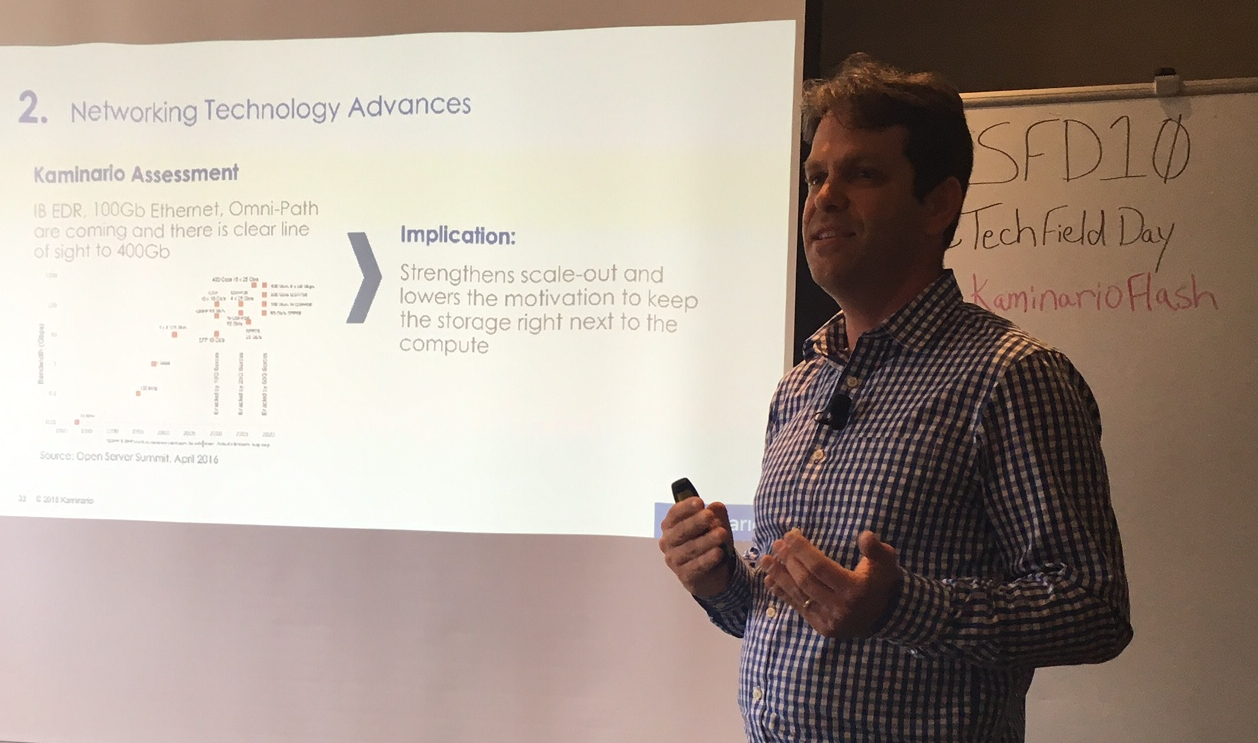
So it’s probably not really fair to say that Kaminario “are doing some stuff we’ve seen before, but that’s okay”. A better description might be that I think there are thematic commonalities between Kaminario’s approach and Nimble, Tintri and Pure’s various approaches to array analytics and understanding workload.
HealthShield
Kaminario have been developing a vision of what they call “DC-aware” storage, with their key imperative being to “simplify and optimise storage deployment and the integration between layers of the IT stack without compromising on cost”. In this fashion they say they differentiate themselves from the current hyperconverged infrastructure paradigm. So what are Kaminario doing?
Firstly, HealthShield is helping them to make some interesting design decisions for the K2 product. What’s HealthShield? It’s “a cloud-based, call-home and analytics engine that delivers proactive monitoring and troubleshooting. Tightly integrated with Kaminario’s world-class support, HealthShield complements high-availability features by ensuring hardware failures never impact availability”. As part of Kaminario’s strategy around understanding the infrastructure better, they’re looking to extend their HealthShield Analytics infrastructure to ensure that storage is both optimised and aware of the full IT deployment.
To this end, with HealthShield they’ve created a Software-as-a-Service offering that helps to “consolidate, analyse, optimise, and automate storage configurations”. While Kaminario’s technical area of expertise is with their storage arrays, they’re very keen to extend this capability beyond the storage array and into the broader application and infrastructure stack. This can only be a good thing, as I think array vendors historically have done something of a shoddy job at understanding what the environment is doing beyond simple IO measurements. The cool thing about making this a SaaS offering is that, as Kaminario say, you can do “Analytics in the cloud so your controllers can work on IO”. Which is a good point too, as we’ve all witnessed the problems that can occur when your storage controllers are working hard on processing a bunch of data points rather than dishing up the required throughput for your key applications. Both Pure and Nimble do this with Pure1 and InfoSight, and I think it’s a very sensible approach to managing your understanding of your infrastructure’s performance. Finally, HealthShield collects thousands of data points, and partners once the customer gives permission.
So What Can I Do With This Data?
Shai Maskit, Director of Technical Marketing (pictured below) did a great demo on Kaminario’s Quality of Service (QoS) capabilities that I think added a level of clarity to the HealthShield story. While HealthShield can be a great help to Kaminario in tuning their arrays, it also provides insight into the right settings to use when applying QoS policies.
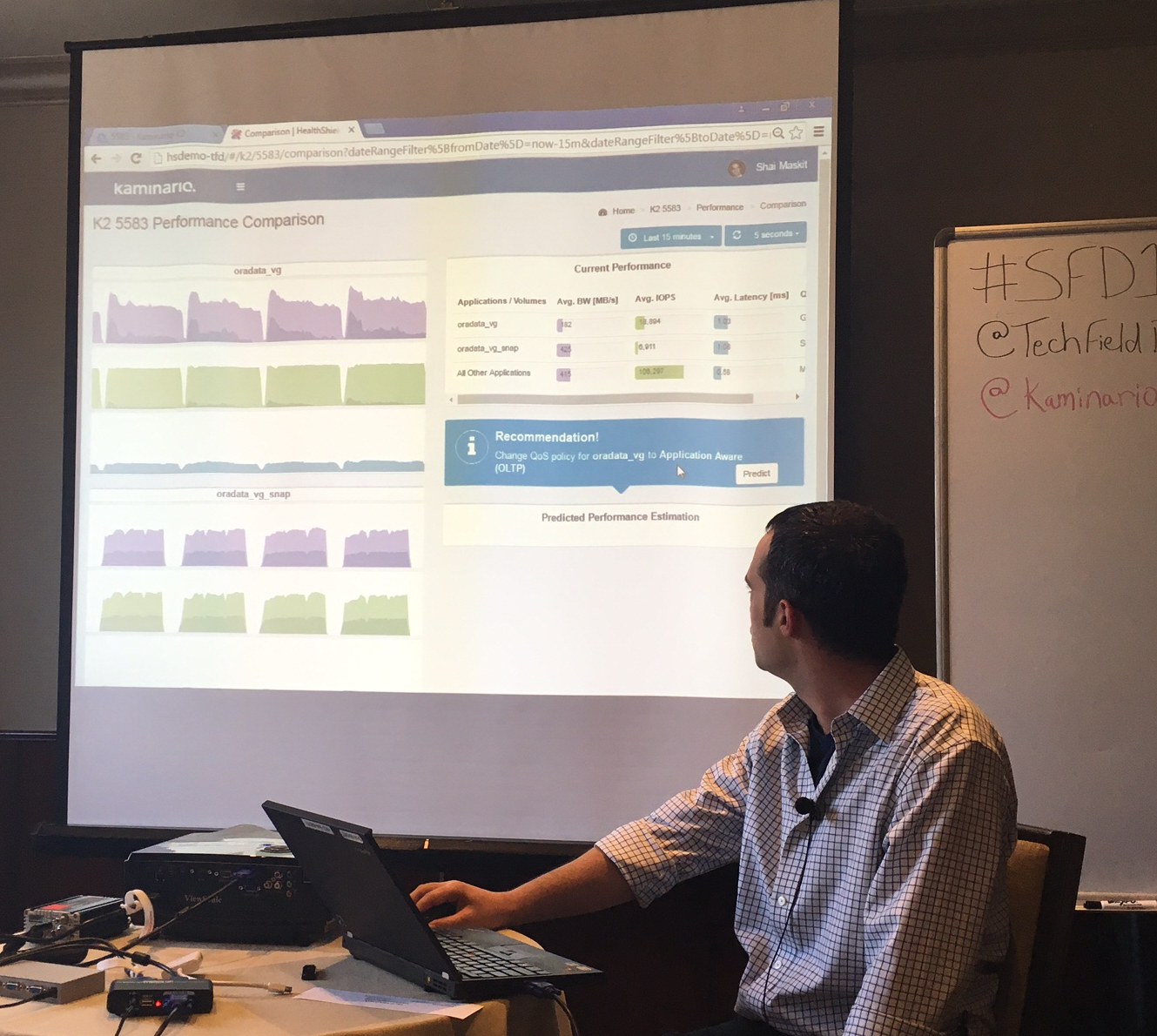
But what’s the problem with QoS that Kaminario are trying to solve? In Kaminario’s opinion, existing QoS solutions are complicated to administer and don’t integrate into the broader set of application delivery operations. Kaminario have set out to do a few things.
Firstly, they want to simplify storage QoS. They do this by abstracting QoS based on customer-defined policies. In this scenario, the customer also defines preferences, not just how to implement QoS in the environment. The key benefit of this approach is that you can then integrate QoS with the application, allowing you to set QoS polices for specific workloads (e.g. OLTP vs OLAP), while closing the gap between the database and its storage platform.
Another key benefit is the availability of performance data, with analytics being made available to detect changing performance patterns and automatically adapt. This also provides insight into workload migration to the K2 environment based on application performance. This can be extremely handy when you don’t want to run everything on your all flash array.
Conclusion
I love that every storage vendor I talk to now is either heavily promoting their analytics capability or gushing about its prominence on their product roadmap. While each vendor does things slightly differently, I think it’s great that there’s been some great progress in the marketplace to extend the conversation beyond speeds and feeds into a more mature conversation around understanding how applications are behaving and what can be done to improve performance to enable improved business operations. QoS doesn’t have to be a super onerous endeavour either. Kaminario have certainly taken an interesting approach to this, and I look forward to seeing how HealthShield develops over the next little while.


