Brisbane VMUG – November 2025

The November edition of the Brisbane VMUG meeting will be held on Thursday 27th November at Christie Spaces, 320 Adelaide St (Room F) from 3pm – 5pm. It’s sponsored by Broadcom and Google Cloud and promises to be a great afternoon.

  • Session 1: Modernize All the Things with VKS in VMware Cloud Foundation (Presenter: Mike Francis – Principal Transformation Architect – Broadcom). VCF Supervisor and Supervisor Services is a pivotal change. In this session we will discuss what Supervisor is, how you should view Supervisor Services as the foundation for your cloud and how this capability modernises on-premise Cloud Operations. We will demonstrate Supervisor and Supervisor Services and draw the connection between it and operations modernisation.
  • Session 2: What’s new with GCVE and native cloud integration (Presenter: Clay Quinn – Senior Solution Architect – Google Cloud). We will explore the seamless architecture between private SDDC and Google’s cloud-native ecosystem, demonstrating how high-bandwidth, low-latency networking enables direct access to services like BigQuery, Cloud Storage, and Vertex AI. Discussion of practical use cases for extending your existing VMware estate, allowing modernization of applications, unification of operations, and leveraging advanced analytics without the risk or complexity of immediate refactoring.

Broadcom and Google Cloud have gone to great lengths to make sure this will be a fun and informative session. You can find out more information and register for the event here.

VMware Cloud on AWS – What’s New – September 2025

It’s been a little while since I’ve posted about what’s new in VMware Cloud on AWS. There have been plenty of enhancements made to the platform, along with a streamlining of capabilities. The more things change, so to speak. That said, I thought I’d put up a short post that covers off some of the key enhancements made available to customers via the SDDC 1.24v5 update that’s currently being rolled out across the fleet. And if you’re trying to work out what on Earth I mean when I refer to 1.24v5, etc., here’s a handy document that’ll help you match up VMware Cloud on AWS releases and the corresponding vSphere components. The VMware Cloud on AWS Release Notes are here.


What’s New?

Non-Stretched Secondary Cluster Support in Multi-Availability Zone Stretched Cluster SDDCs

It’s a bit of a mouthful, but let me dig in. I’ve posted about the utility of stretched clusters previously (and I’m thinking of writing about it again based on some conversations in the past month). Stretched clusters have historically been a cool way to ensure that your workloads are protected across multiple Availability Zones in the event that one or more components (or hosts or even the whole Availability Zone) go away. One of the constraints with VMC on AWS stretched clusters, however, has been that an SDDC with a stretched cluster could only ever contain stretched clusters – there was no opportunity to mix topologies within the SDDC construct. So, one organisation I know of has its production workloads running on a stretched cluster on one SDDC, and its non-production workloads running on another SDDC. While it’s not the end of the world, it makes things slightly more fiddly from a management perspective, and duplicates some of the work required when it comes to firewall configurations, user creation, workloads mobility, and so forth. The VMC team has recognised this, and has now announced that VMC on AWS will have support for secondary non-stretched clusters in the same SDDC as stretched clusters.

There are, of course, a few caveats to be mindful of. Firstly, you need to be on 1.24v5. Secondly, the primary cluster needs to be a stretched cluster – you can’t add stretched clusters to non-stretched SDDCs. Thirdly, you can’t convert stretched to non-stretched and vice versa. Once the clusters are configured the way they are, you’ll need to keep them that way. Fourthly, the non-stretched clusters can only be deployed in one of the Availability Zones in which you’ve deployed your stretch cluster. You couldn’t, for example, deploy a stretched cluster in AZ1 and AZ2, and deploy a non-stretched cluster in AZ3, while hoping to keep this all in the same SDDC. Finally, the minimum non-stretched cluster size is three hosts, not two.

Default and Maximum Virtual Machine Hardware Version Increased

From the release notes, “[t]he default virtual hardware version has been increased from Virtual Hardware 14 (vSphere 6.7 compatibility) to Virtual Hardware 19 (vSphere 7.0 U2 compatibility). The maximum virtual hardware version has been increased from Virtual Hardware 19 (vSphere 7.0 U2 compatibility) to Virtual Hardware 20 (vSphere 8.0 compatibility)”. This really helps with compatibility with newer Windows and Linux guest operating systems while still providing the (crucial) ability to move workloads between VMware hosts on various cloud and on-premises platforms.

Increased NFS Throughput

Of note with the 1.24 release, “the MTU on VMK0 has been increased to 8500”. It’s reported that this increases large block throughput by up to 20% for NFS Datastore workloads. This is becoming increasingly important as customers look to leverage NFS-based storage solutions like FSx for NetApp ONTAP for less latency-sensitive storage workloads that don’t need to be hosted on vSAN.


Thoughts

While I’m excited about the General Availability of Amazon Elastic VMware Service, that doesn’t mean that VMware Cloud on AWS is dead. The VMware Cloud on AWS product and engineering teams have continued to work on releasing innovative features and important, incremental improvements. The encouraging thing about this is that they are listening to customers, particularly around things like mixed cluster topologies, and continuing to adapt the solution architecture to satisfy those requirements. This is a good thing for both existing and potential customers. If you looked at VMware Cloud on AWS three years ago and ruled it out, I think it’s worth looking at again.

Random Short Take #104

Random short take #104. Want news? This is where news goes to die. Let’s get random.

Amazon Web Services – Elastic VMware Service – A Few Notes …

Amazon Web Services (AWS) recently announced the general availability of its Elastic VMware Service (EVS). This is a brief post covering what the service is, how it can be consumed, and why it might be of interest.


What Is It?

EVS is a service that provides the ability to run VMware Cloud Foundation (5.2.1) on AWS bare-metal instances (specifically I4i.metal). It’s a by-the-book consolidated architecture (running management and workload domains together), and contains the following VCF management components:

  • ESXi hosts;
  • vCenter Server instance;
  • SDDC Manager;
  • vSAN datastore;
  • Three-node NSX Manager cluster;
  • vSphere cluster; and
  • NSX Edge cluster.

Storage is provided by vSAN (and selected third-party storage integrations), with two discrete network layers being delivered: the Amazon VPC and the VMware NSX overlay network. You can read more about the architecture here.

To consume the service, you’ll need 4 nodes to get started, along with at least 2 VPC Route Servers, and AWS Enterprise Support. There’s a pricing calculator on the AWS website. You’ll also need to procure VCF licensing from Broadcom or an authorised reseller.


Where Is It Available?

The initial launch Regions are:

  • US East (North Virginia)
  • US East (Ohio)
  • US West (Oregon)
  • Asia Pacific (Tokyo)
  • Europe (Frankfurt)
  • Europe (Ireland)

Availability in more Regions is planned for the future.

Other Considerations

Storage

You can leverage NetApp’s FSx for NetApp ONTAP service to provide additional storage for the cluster. There’s some useful guidance here and here. If you like it more orange, Pure Storage’s Cloud Block Store is also available for use with EVS. You can read that announcement here.

Clusters

Cluster sizes are currently limited to between 4 (minimum) and 16 (maximum) nodes. There is currently no support for stretched clusters. This will likely change in the future.

Add-ons

Services that VMware Cloud on AWS users may be familiar with, such as vDefend Advanced Threat Protection, and VMware Live Cyber Recovery, are not currently available with EVS.

Planning and Deployment

Much like VMC on AWS (and most other cloud service deployments, for that matter), there’s a bit of planning you’ll need to do before you jump on the console. There’s a handy checklist that takes you through all of the requirements here. It’s also worth noting that, unlike VMC on aWS, this isn’t a managed service, so some of the VPC constructs you see with VMC on AWS aren’t used with EVS. For example, there’s no shadow VPC deployed for EVS – it’s all done out of the customer account. And features like EDRS aren’t available, you need to manage your capacity yourself, in much the same way as you would do with an on-premises VCF deployment.


Thoughts

EVS is the same as VMC on AWS in the sense that it’s running VMware software on top of AWS bare metal servers. There are plenty of differences though, some of which I’ve covered above. I imagine many of the constraints around additional product integrations and scalability will be removed in the near future as the product evolves, and we’ll no doubt see some changes when it comes to partners offering managed services wrapped in with EVS. It’s been a while coming, but now that it’s here, I’m interested to see how the market responds. There are probably plenty of questions I haven’t answered, but there’s a useful FAQ document here.

Random Short Take #103

Random short take #103. Want news? You’re probably not in the right place. Let’s get random.

StorPool Announces Disaster Recovery Engine For KVM-based Clouds

StorPool recently announced its Disaster Recovery Engine (DRE) for KVM-based clouds. I had the chance to talk to Dave Henry and Beth Caltagirone about the announcement and thought I’d share some thoughts here.


What It Does

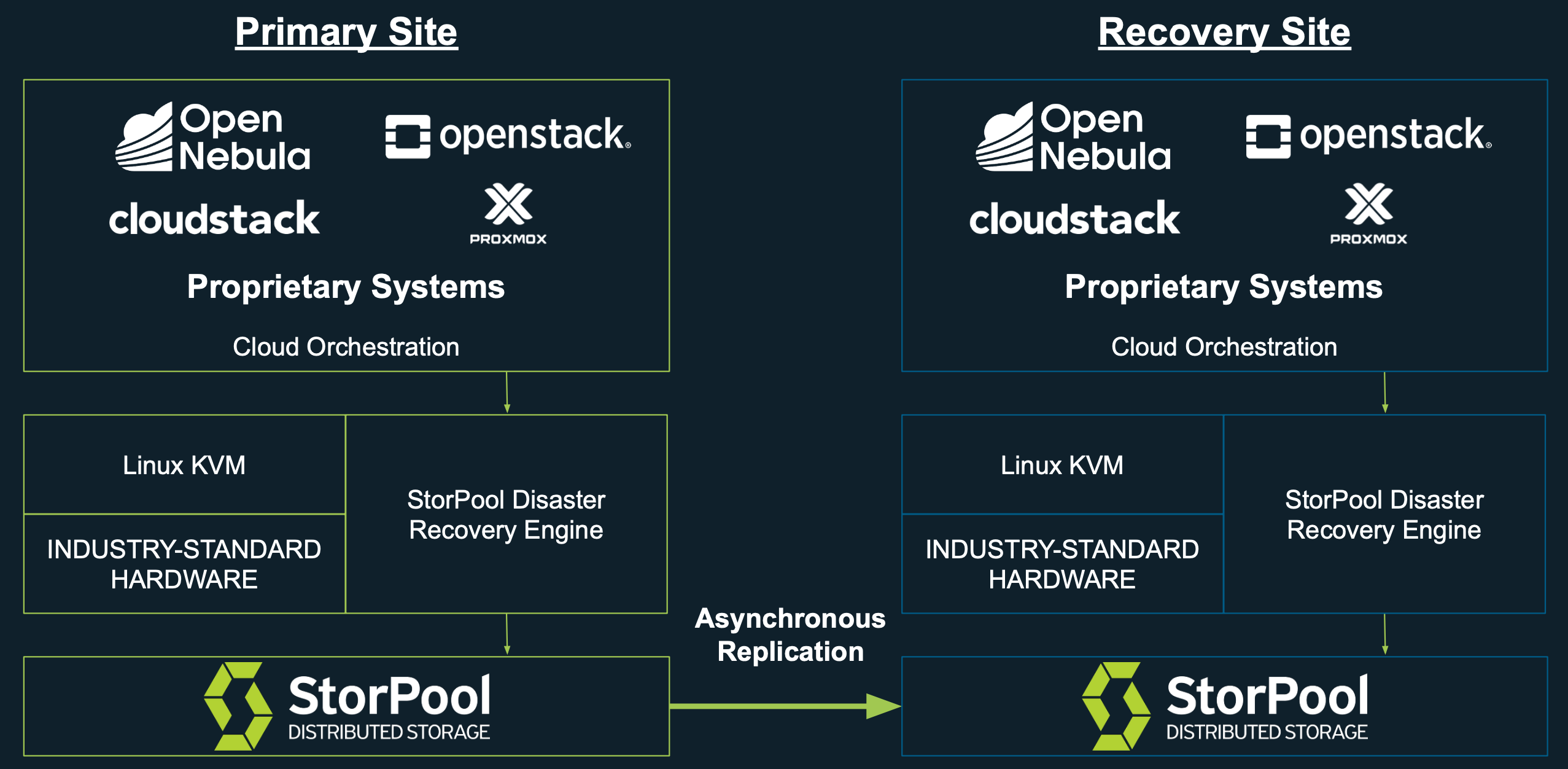
According to StorPool, the DRE “can protect environments with tens to thousands of VMs. It simplifies disaster recovery scenarios like 1:1, many to 1, many to many, and delivers industry-leading recovery point objective (RPO) and recovery time objective (RTO) of virtual machines in disaster scenarios, to ensure uninterrupted business operations.” At its core, it’s a way to get data from point A to point B, and use that data in the event that point A goes away.

[image courtesy of StorPool]

It supports asynchronous replication down to a 15-minute recovery point objective, and, according to Henry, can deliver some pretty snappy recovery times (depending on the hardware deployed at the recovery site).

Supported Topologies

There are several topologies supported, including:

  • Active – Passive;
  • Bi-directional;
  • Many-to-one; and
  • Multi-site mesh.

The choice of topology will be dependent on various environmental factors, such as distance between sites, the type of disaster you’re looking to recover from, etc. But I’m sure this level of flexibility would be appreciated by StorPool customers.

Licensing

Existing and new customers will be pleased to hear that the StorPool Disaster Recovery Engine is fully integrated with StorPool’s existing licensing – no additional license is required.


Who’s Using It?

“StorPool customers are IT service providers building public, private and hybrid clouds – Managed Service Providers, Hosting Service Providers, Cloud Service Providers, Enterprises and SaaS vendors. The StorPool Storage platform is a Storage-as-a-Service (STaaS) offering, with a bring your own server model.” CloudSigma has been using the product to offer DR capabilities to its customers across 31 sites globally.


Thoughts

In terms of hypervisors, I’ve been working almost exclusively with VMware for the last twenty years (well, except for that weird XenServer dalliance in the early 2000s), so my knowledge of KVM-based solutions, particularly when it comes to disaster recovery and orchestration, is fairly limited. That said, I’ve been following StorPool for some time, and have seen the offering develop over time to meet the needs of service providers looking to do cool stuff with software-defined storage solutions. The ability to provide some useful DR replication and orchestration seems to be a logical progression for a company that helps service providers deliver storage and cloud services to its customers, and that slo offers its own managed services as part of the arrangement. The company has always been focussed on an API-first approach, and this carries over to the DRE offering as well. I’m always happy to hear about companies working to deliver more DR capabilities to their products, particularly when there’s been a bit of a gap in the capability previously. And I’m especially happy to hear that this capability is being included at no additional cost.

The StorPool DRE is now in public beta and GA is scheduled for Q2 2025. I’m keen to hear how the solution is being adopted with StorPool customers and looking forward to hearing more about how StorPool are innovating in the market.

NetApp Cloud Storage Announcements – February 2025


NetApp recently made some announcements around its cloud storage capabilities as part of a larger series of product announcements. I thought I’d share some notes and some brief thoughts here.


Azure NetApp Files

New capability – Cost optimisation

New capability – Resilience

There’s also preview support for backing up large volumes and performing single file restores from backup.


Amazon FSx for NetApp ONTAP

There’s a new AWS CloudFormation package Amazon FSx for NetApp ONTAP that unlocks advanced ONTAP operations, including:

  • SnapMirror creation (including ClusterPeer and SVM Peer);
  • iSCSI (LUN and iGroup) creation;
  • CIFS Share creation;
  • Snapshot and Snapshot Policy creation; and
  • Advanced Volume creation.

[image courtesy of NetApp]


Thoughts

Why am I writing about FSx for NetApp ONTAP on my weblog? And why should you be interested in a few minor enhancements to this and to Azure NetApp Files? How do these technologies even make sense when the benefits of public cloud are right there? Why would organisations not just use the hyperscaler-native storage solutions available to them? It’s for the same reason that numerous organisations have adopted VMware Cloud on AWS and Azure VMware Solution, sometimes your applications need something different to what the public cloud can offer, at least until those applications have undergone some kind of transformation. I have plenty of customers in my day job taking advantage of FSx for NetApp ONTAP with their VMware Cloud on AWS deployments because the linear scalability of hyper-converged infrastructure has proven problematic for storage-heavy workloads. Additionally, they get the benefit of being able to leverage the NetApp tools they know and love, just in a cloud context. It’s great to see NetApp continue to add features and functionality to both Azure NetApp Files and FSx for NetApp ONTAP. If you’re struggling with shifting storage-dense workloads to public cloud while needing to stay within the confines of a VMware-based solution, these offerings can really help the economics make sense, even for enterprises, not just the t-shirt and jeans cloud-native types.

VMware Cloud on AWS – TMCHAM – Part 14 – Stretched Clusters and Disaster Recovery

In this edition of Things My Customers Have Asked Me (TMCHAM), I’m going to cover some of the things to consider when looking at Disaster Recovery (DR) and availability solutions on the VMware-managed VMware Cloud on AWS platform. It might seem like basic stuff if you’re already using the platform, but there are plenty of customers I talk to that are struggling to distinguish between DR, data availability, and periodic data protection in a VMware Cloud context.


Terminology

I’m cheating a little here and re-using some of my older content, but I think it still holds up.

  • Disaster Recovery – Disaster Recovery is the ability to recover applications after a major event (think flood, fire, data centre is now a hole in the ground). This normally involves a failover of workloads from one DC to another in an orchestrated fashion. In a VMware context, you would use VMware Live Recovery (Site or Cyber, depending on the environment).
  • Disaster Avoidance – Disaster avoidance “is an anticipatory strategy that is in place in order to prevent any such instance of data breach or losses. It is a defensive, proactive approach to keeping data safe” (I’m quoting this from a great blog post on the topic here). In a VMware context, this would be a stretched cluster using vSAN on VMware Cloud Foundation or in VMC on AWS.
  • Periodic Data Protection – This is the kind of data protection activity we normally associate with “backups”. It is usually a daily activity (or perhaps as frequent as hourly) and the data is normally used for ad-hoc data file recovery requests. Some people use their backup data as an archive. They’re bad people and shouldn’t be trusted. You should consider PDP as separate to DA or DR solutions.


So How Do I Best Protect My Workloads? (Part 1)

Understand Your Workloads

You need to understand how your applications work. And you need to understand what talks to them and what they talk to. There are plenty of ways of doing this, including a variety if applications available that scan network traffic and draw pretty pictures of data flows for you. From experience, there’s a very good chance you won’t get this information by reading current documentation, because it won’t be current.

You need to understand how important your applications are to you. Do you need to recover them immediately if something goes wrong? Can you do without them for a few hours? A few days? How much data can you afford to lose? All of it? (in which case why do you still have this data sitting around?). None of it? Some of it? You need to be disciplined and thorough in your assessment of your workloads and what they mean to your business, because protecting them or recovering them can be an expensive exercise.

Understand What Scares You Most

What do you call a disaster? Is it a data centre turning into a hole in the ground? Do you run most of your workloads in an area prone to natural disasters? Or are you more worried about people in hoodies breaking into your infrastructure and encrypting it and your data protection infrastructure? (Hot tip: you absolutely should be worried about this). You need to be fairly paranoid about the scenarios you’re trying to protect your environment from. No one thought it was a problem keeping workloads in two buildings in New York until it was. At the same time, you’ll need to introduce some pragmatism into your planning. I’ve had customers ask me what they could do if all of the Sydney Region was wiped out (not just the AWS deployment, but the whole city). Could they recover data to Melbourne? Sure. Would they have any staff left to do it? Or want to do it? Depending on the nature of the disaster, the technical aspects of disaster recovery are going to be the easy bits. You still need to make sure the people and process bit is covered.

Who Can Help You? 

Do you want to handle any recovery activities yourself when things go bang? Or are you happy to let someone else do the heavy lifting for you? Some folks don’t trust outsiders to do “important” things, like recover workloads, whilst other organisations would consume absolutely everything as a service if it was an option.

How Much Can You Spend?

You need to answer the questions above before you can answer how much you’re willing to spend on one (or more) solutions to help keep your workloads protected. If your apps aren’t that important, or your business can continue to run without access to these apps for a period of time, then you’re going to be less inclined to go for the “platinum” solution. But if you’re whole business relies on applications being available 24/7/365, then you’re hopefully more understanding that you’ll need to invest.


So How Do I Best Protect My Workloads? (Part 2)

Data Availability with VMware Cloud on AWS

As I mentioned earlier in this post, if you’re looking to provide data availability for your workloads on VMware Cloud on AWS, you should be looking at deploying a stretched cluster solution. In short, stretched clusters in VMware Cloud on AWS are designed to protect against an AWS availability zone (AZ) failure. There’s a feature brief available here that goes into more depth on the solution. Key things to note are that the vSAN stretched cluster is deployed across 3 AZs (2 workload, 1 witness). So you could have 3 hosts in one AZ, 3 in another, and VMware deploys a witness node in the third site as part of the deployment. From the document, “vSAN Fault Domains are configured to inform vSphere and vCenter which Hosts reside in which AZ. Each Fault Domain is named after the AZ it resides within to increase clarity. Logical networks are also extended using NSX to support workload mobility across the two AWS availability zones”. You also have the option to keep data using various vSAN storage policies, including:

  • Dual-site mirroring (stretched cluster)
  • None – Keep data on primary (stretched cluster)
  • None – Keep data on secondary (stretched cluster)

Why would you not just mirror everything? Cost. Some applications simply don’t need that level of resilience, but it’s too complicated to deploy multiple SDDCs to support multiple deployment topologies (you can’t have a mix of single AZ and stretched clusters in the same SDDC), so customers can keep a mix of workloads in the same deployment. Note also that external storage solutions (like FSx for NetApp ONTAP) aren’t supported for use with stretched clusters. vSphere HA will restart the VM on the surviving AZ if a site failure is detected. There’s a short video on YouTube that covers a stretched cluster deployment and is worth looking at.

Disaster Recovery with VMware Cloud on AWS

I’ve covered VMware Live Cyber Recovery (and its predecessor, VMware Cloud Disaster Recovery) on this blog before. It’s a great solution to protect on-premises, GCVE, and VMware Cloud on AWS workloads.  It provides protection to a secure cloud filesystem with a Recovery Point Objective as low as 15 minutes, the ability to perform guided ransomware recovery in an isolated environment, and SaaS-based recovery automation. The kind of things you want to consider when evaluating the suitability of VLCR to your needs would be:

  • Recovery Point Objective – the maximum amount of time in which data may have been permanently lost during an incident. VLCR goes down to 15 minutes, but if you need lower than that you need to look at other architectures.
  • Scalability – how many Virtual Machines and how much storage are you trying to protect? And how quickly do you want to recover it? And where do you want to recover it to? Some folks don’t like VMware Cloud on AWS being the only recovery option, but VMware has announced “plans to enhance VMware Live Recovery support for Google Cloud VMware Engine (GCVE) as a cyber and disaster recovery (DR) site, for both on-premises as well as GCVE environments“. You can check out the configuration maximums for VMware solutions here.
  • Networking and security – how will you access your recovery workloads? Will you use HCX to have stretched networks between your protected sites and your recovery site? What does that look like for your core networking infrastructure? Is your CISO happy to recover stuff onto a cloud platform? There are many things you’ll need to work through internally to ensure people are comfortable. I’d also recommend you go with a pilot light deployment as opposed to an on-demand solution. While the pilot light option seems more expensive, it will save you when something goes wrong and you’ve already tested your deployment.
  • Other Considerations – there’s a bunch of info in the legacy VCDR Release Notes that highlight some of the constraints to be aware of from an architectural standpoint, and understanding some of these (like the ability to protect stretched clusters, but not recover to stretched clusters) is key to ensuring your architecture will work when you push the button. And one point that is often missed by folks looking at VLCR for the first time is that, as the recovery SDDC is just a VMware Cloud on AWS deployment, you can use it for other workloads in the meantime, like dev/test stuff, when you’re not in a recovery situation.

Periodic Data Protection with VMware Cloud on AWS

There are a tonne of different things you can do here, and I’d be naive to suggest that I could cover them all effectively in this post. To use periodic data protection solutions with VMware Cloud on AWS, you should check out this KB article, and work with your data protection vendor to ensure that the solution has been tested and works on VMware Cloud on AWS. I’ve encountered a few situations where the vendor has assumed that VMware Cloud on AWS works the same way as VMware on-premises, and with the same ability to do silly things with privileged access to ESXi hosts and things of that nature. There aren’t a lot of restrictions in place, but there are some important ones, like the aforementioned limits on direct host access, restricted account privileges, and so on. Just make sure you test it before you buy it. I’ll try and cover some of the scenarios that do and don’t work in a future post (without naming too many names).


Conclusion

I’m sticking with solutions available with VMware Cloud on AWS in this post, mainly because that’s what I’m talking to people about on a daily basis. But there’s plenty here that can be applied more generically to a variety of infrastructure solutions. You’ll have the same questions you’ll need to ask when it comes to protecting workloads on-premises (regardless of your choice of hypervisor), and you’ll need to make some hard decisions ab out what you want to protect depending on the value of what your workloads deliver to the business, and the available budget. You might also need to consider doing a combination of all three options, depending on the importance of the data / workloads you’re looking after. I’d always pick stretched clusters to keep my workloads up and available, but that won’t help me if some hacker decides to dump ransomware in my environment and encrypt all of my stuff. But if I need to go back 24 months to retrieve some file for an auditor, I wouldn’t use VMware Live Cyber Recovery for that. I should also mention that you should be using application-level protection as your first option for application resilience too. This other stuff is all infrastructure level, and potentially not as elegant, depending on your applications. But that doesn’t mean you can’t combine both methods. Unfortunately, there’s no one magical fix for this problem, but with a bit of planning, and some critical evaluation, you can protect your workloads against all manner of bad situations. And if you can’t do everything, at least do something, but just make sure people in your business understand the difference between the two. And remember, you’re only as good as your last recovery.
VMware Live Cyber Recovery Link-O-Rama

Background

It’s been just over six months since VMware Live Recovery was announced. This is an umbrella product name for VMware Live Site Recovery (formerly known as Site Recovery Manager) and VMware Live Cyber Recovery (formerly known as VMware Cloud Disaster Recovery and Ransomware Recovery). Like many of the changes at VMware this year, this is a move designed to streamline the disaster recovery solutions being made available for VMware Cloud Foundation, and to make it simpler for you to choose which product works best for you.

To that end, I’ve put together a series of links from the documentation that I’ve found useful when talking with customers about VMware Live Cyber Recovery in particular. I figured if my customers were asking about these things, someone else might find the answers useful too. This isn’t comprehensive, but hopefully it’s of some use.


Link-O-Rama

Maximum Configs

Here are the current configuration maximums for VMware Live Site Recovery, VMware Live Cyber Recovery, and local vSAN snapshots. Why would you need to know these? There are useful things to know that differentiate the products, such as the recovery point objective values, virtual machine limits, and so on. Remember, these should be treated as limits, not targets, and if you have an environment that exceeds these limits, reach out to your account team to talk about it.

Networking Considerations

  • Does your security team want to know more about the Cyber Recovery (formerly DRaaS) connector? Check out this document.
  • Can you use Direct Connect instead of clobbering my Internet feed? Yes, here’s how. Want to know more about AWS Direct Connect (useful if you’re new to AWS)? This article should help.
  • What holes do you need to punch through my firewall for things like support and telemetry data uploads? This article on Service Public IP Addresses should help some.
  • Can you throttle the bandwidth that the replication uses? Yes, you can. The documentation is here.
  • Need to configure different IP addresses for your recovered virtual machines. This documentation should help.

How Do I Use It?

You can find (a slightly dated) copy of the VMware Cloud Disaster Recovery Admin Guide in PDF format here. Some things have changed with the switch to VMware Live Cyber Recovery, but the fundamentals remain the same, and it’s handy to have a downloadable copy of the admin guide, particularly when you’re in a situation where your data centre is on fire and your Internet connection is a melted mess.

Want to get a better feel for how VMware Live Cyber Recovery handles? Check out this Hands-on Lab.

Release Notes

The overall release notes for VMware Live Recovery are available here. You’ll see interesting bits of news, such as “VMware Cloud Director Availability is now part of VMware Live Recovery”. You can also drill down into the VMware Live Cyber Recovery documentation here, and the VMware Live Site Recovery 9.0 documentation can be found here. If you need to dig through some historical release notes (or just want to take a trip down memory lane), you can view the VMware Cloud Disaster Recovery release notes archive here.

But I Have More Questions

  • There’s a great set of Frequently Asked Questions on VMware Live Recovery in PDF format that can be found here.
  • How do you know if you need disaster recovery or ransomware recovery (or both)? This is a great article covering some of the considerations that you’ll need to think about.
  • Are you looking at backup solutions for VMware Cloud on AWS? This is a comprehensive article on using third-party backup and recovery tools with VMware Cloud on AWS.
  • Looking to leverage VMware Site Recovery on VMware Cloud on AWS? It has gone away, and you should consider moving to VMware Live Cyber Recovery.
  • Wondering about the overall security of the VMware Live Cyber Recovery product? The Cloud Security Alliance performed a VCDR Assessment that you can access here.


Conclusion

And that’s about it. I’ve published a few posts on this weblog covering VMware Cloud Disaster Recovery in the past, and you can find them here. While some of the screens might look a little different now, the vibe remains unchanged. If you have questions that I haven’t answered here, feel free to reach out and I’ll see if I can help.

Random Short Take #95

Welcome to Random Short Take #95. Let’s get random.

  • Chris M. Evans put together an editorial on why centralised storage refuses to go away. I thought the point about ransomware was an interesting one, although some of the systems I’ve seen out there haven’t been secured terribly well.
  • Speaking of storage and ransomware, there’s an excellent article over at Backblaze on Object Lock. Worth checking out as I think a lot of people like to talk about Object Lock without understanding what it is (and isn’t).
  • Speaking of storage, Mellor covered a recent presentation by Tom Lyon – eminent Sun alumnus says NFS must die. I came from the block side of things, so NFS was always a little quirky but gee whiz you can do some good (and dumb) stuff with it.
  • I’ve followed Frances for some time, and really enjoyed this article on her experiences in the transition from VMware to Broadcom. I think everyone’s journey has been different, and it’s invariably a little more nuanced than The Register would have us believe. But as I’m an employee that’s probably all I’ll say about that publicly.
  • Speaking of Broadcom, Tony put together this excellent article on Cloud Director Tenancy Container Applications. It’s very thorough, and he’s promised me he’ll be doing more soon.
  • In press release news, Hammerspace are dong stuff with GPU data orchestration capabilities to accelerate access to S3 data. If you haven’t looked into Hammerspace, you really should.
  • In other PR news, Datadobi has unveiled StorageMAP 7.0. I tried to catch up with the Datadobi folks before I went on leave but it didn’t work out. Hopefully I can get hold of them to dive in a little deeper on this in the near future.
  • Finally, JB published a great piece entitled Existential Having. If you follow me on the photos social media you’ll know that I have a lot of records. And basketball jerseys. And sneakers. I don’t know why I have these things, but they bring me comfort. For a period of time. And then I Marie Kondo that crap and start all over.