
NetApp recently made some announcements about enhancements to its enterprise storage line of products. I thought I’d share a few notes here.
ASA A-Series
If you’re unfamiliar with the ASA line of devices, it’s NetApp’s all-flash SAN solution. There are a few models already available (see the data sheet here) and now there are three more A-series models: the ASA A50, ASA A30, and ASA A20.

[image courtesy of NetApp]
Major Hardware Innovations
There’s an integrated compression offload engine with Intel® QAT®1 (this is not available with the ASA A20), delivering the following benefits:
- Next generation CPU architecture provides increased performance for resource-intensive tasks and processing
- Always-on enhanced storage efficiency without impacting performance
- Up to 160Gb/s data compression
It takes advantage of PCIe Gen 5, as well as DDR 5 Memory. According to NetApp, this delivers twice the clock speed for faster memory access and 50% more throughput for large data transfers. Additionally, there’s support for 64Gb Fibre Channel and NVMe/FC, as well as 100GbE and NVMe/TCP support. They use Titanium power supplies with a 95% efficiency rating.
Storage efficiency
You also get access to “always on, inline, data reduction”. There’s no cold data policy to manage, nothing for customers to configure and, according to NetApp, it’s easy to meet Storage Efficiency Guarantee ratios. Thanks to QAT, you’ll never need to choose between performance or efficiency.
New FAS and EF-Series systems
FAS50
The FAS50 delivers quite a punch in a small 2U form factor, with:
- Optimised I/O flexibility;
- Improved price/performance value;
- Enabled for future security hardware offload; and
- Released with ONTAP 9.16.1 GA.

[image courtesy of NetApp]
EF Series
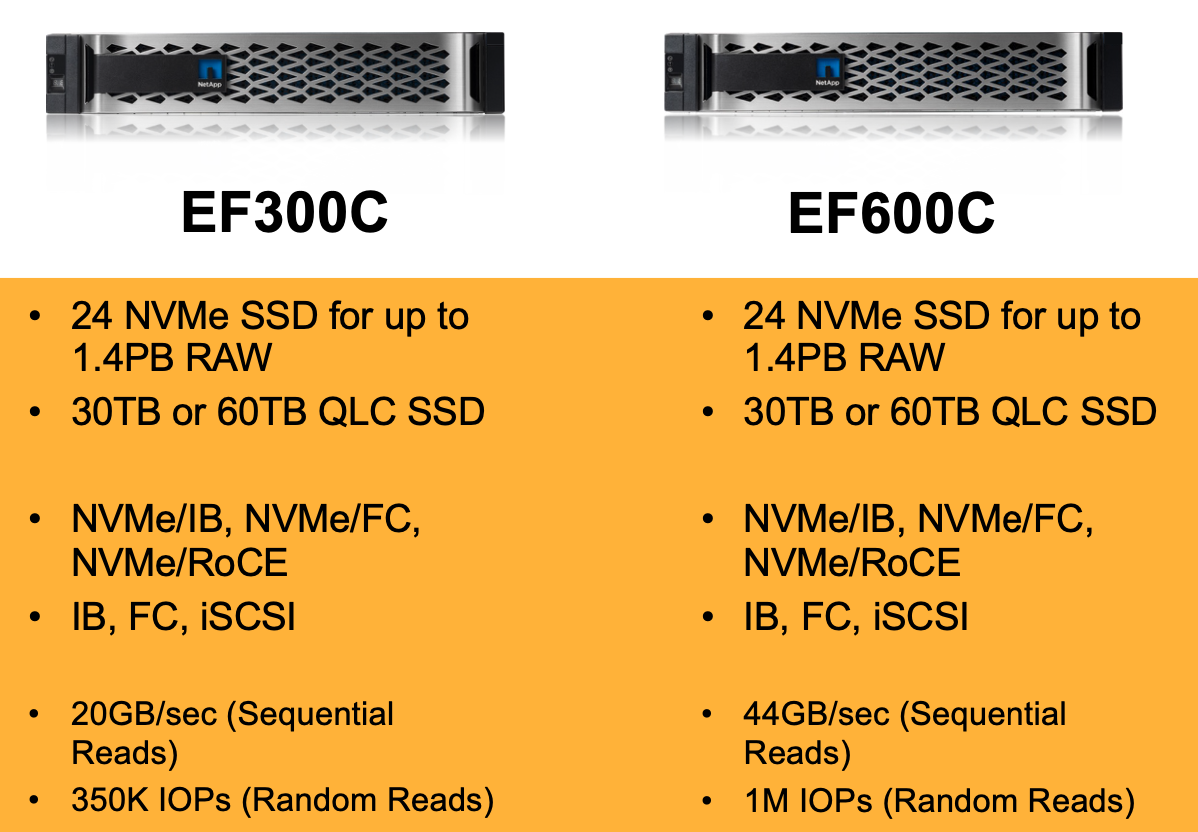
NetApp has also announced the availability of new EF-Series arrays – the EF300C and EF600C.
[image courtesy of NetApp]
A few things to note with the EF300C and EF600C:
- The default configuration is a single Dynamic Disk Pool (DDP) which is automatically created using all available drives for simplicity in management
- There is support for 30TB or 60TB capacities (but by default there is no mixing of capacities in a shelf)
- There is only support for QLC NVMe SSDs (No mixing of QLC or TLC NVMe SSDs allowed)
- Available with a minimum of 12x up to a maximum of 24x QLC NVMe SSDs (No expansion shelf capability)
Thoughts
It’s been a minute since I wrote about a storage company’s product announcement. The news from NetApp piqued my interest, however, as it seems like the portfolio of products and options has developed into something broader than what NetApp was traditionally known for (and I know there’s even more news that was announced that I haven’t covered here). Whilst I talk a lot about how useful the cloud is in my day job, it’s hard to dispute that I/O (and storage in general) can still have a massive impact on the performance and usability of critical and not so critical applications alike. Additionally, having options in terms of scalability, performance, and transport mechanisms, is key to delivering the right storage platforms to the applications (and end users) that need them. But while I’ve dumped a lot of speeds and feeds into this article, ultimately the success of a storage company like NetApp is more about how the platforms can be managed, integrated with other systems, and upgraded from one version to the next.
If you’re running everything in one of the hyperscalers (or more than one, for that matter). you’re not going to be terribly interested in what NetApp is selling. Despite the fact that NetApp is doing some cool stuff with hyperscalers as well (that I’ll cover in a separate post). But a large percentage of the world’s critical workloads are still hosted on what we might term “traditional” storage appliances hosted in data centres across the globe and accessed and managed in a similar fashion to the way they were 5 or 10 years ago. But that doesn’t mean that companies like NetApp aren’t innovating. Indeed, looking at some of the specs and numbers being touted here, it’s easy to see why companies are sticking with the likes of NetApp when it comes to hosting enterprise workloads on enterprise storage. I don’t think the end of traditional storage is here by any stretch, and I’m pretty sure there’s more innovation to come.